
The RV water pump is what gives you running water when you’re not hooked up to a campground spigot. It pulls water from the fresh tank and pushes it to the faucets, shower and toilet whenever you open a tap. When it works, you never think about it. When it stops, gets noisy, cycles on and off or won’t build pressure, your whole water system feels broken, even though the fix is often simple.
This guide explains how an RV water pump works, what the common problems look like, and how to troubleshoot them step by step.
How an RV water pump works
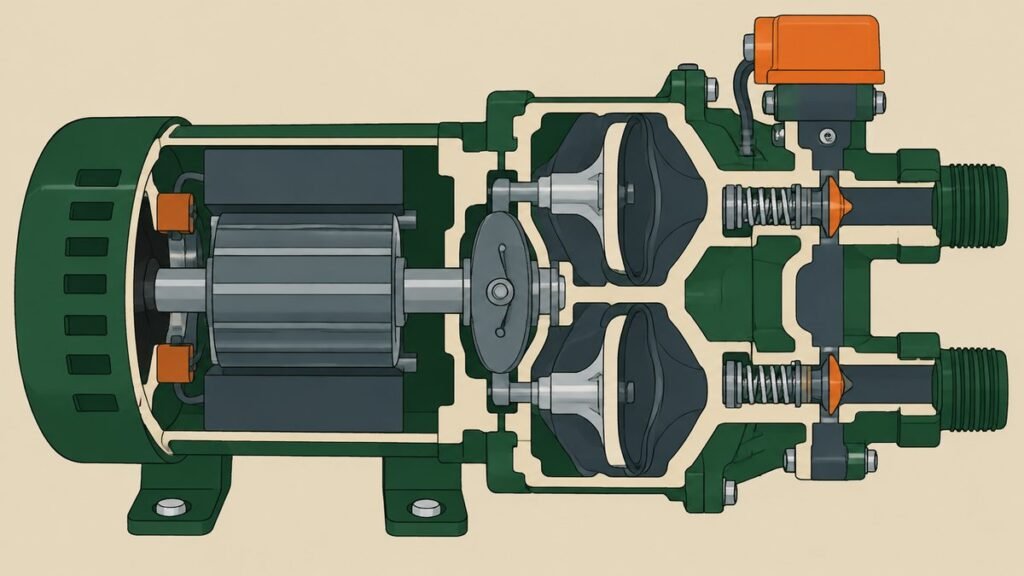
Most RVs use a 12-volt diaphragm pump. A small electric motor drives a mechanism that flexes diaphragms back and forth. This draws water in through an inlet, usually through a strainer, and pushes it out through the outlet into the RV’s plumbing. A pressure switch on the pump senses when water pressure drops, such as when you open a faucet, and turns the motor on. When the faucet closes and the pressure builds back up to a set level, the switch turns the motor off.
Some pumps are designed to run dry briefly without damage, and many have a built-in check valve to keep water from flowing backward. A pump runs on 12-volt power from your house battery or converter, so a weak battery can also cause pump problems.
Pump and accumulator tanks
Some RVs add an accumulator tank, a small pressurized tank that smooths out the pump’s pulses and reduces cycling. It holds a cushion of pressurized water and air, so the pump doesn’t have to start every time you open a faucet slightly. If your pump pulses or cycles rapidly, an accumulator can help.
City water vs the pump
When you connect to city water, the pump isn’t used. Water comes in through the city water inlet and bypasses it, and a check valve prevents it from flowing backward into the tank. The pump only runs when you’re drawing from the fresh tank. Always set your pressure first by using a water pressure regulator at the spigot, and switch the pump off when you’re on city water.
Common RV water pump problems
Pump doesn’t run at all
- Check the pump switch and make sure it’s on.
- Check the 12-volt power. A dead battery, loose connection or blown fuse can stop the pump. A multimeter helps you check voltage at the pump.
- Check the fresh tank. If the tank is empty, some pumps will run but won’t deliver water, while others may not run at all.
- Check the pressure switch. A failed switch won’t start the motor.
Pump runs but no water comes out
- Check the water level in the fresh tank.
- Check for an air lock. After filling the tank or winterizing, air in the lines can stop the pump from priming. Open a faucet on the hot side and cold side to let air escape.
- Check the inlet strainer. It can clog with debris and starve the pump.
- Check for a closed valve or a kinked or collapsed inlet line.
- Check the water pump converter valve, if you have one, to be sure it’s closed after winterizing. See our guide on how to winterize an RV.
Pump runs constantly
- There’s a leak. Check under sinks, around the water heater, at fittings and at the toilet. A leak lets pressure drop so the pump keeps running.
- Faucet open or water heater drain open. Make sure everything is closed.
- The pressure switch is failing or isn’t adjusted properly.
- Worn diaphragms or valves. The pump can’t build full pressure.
- The tank ran out of water. The pump may run until it’s refilled.
Pump cycles on and off rapidly
A fast, repeated cycle often means a small leak, a failing check valve, air in the lines or a lack of an accumulator. Check for drips and open faucets. If you have no accumulator, adding one can smooth things out.
Pump is very noisy or vibrates
Some noise is normal, but loud rattling or vibration can mean the pump isn’t mounted securely or lacks rubber isolation feet. Hoses touching walls can carry vibration. A worn bearing or damaged diaphragm may also make noise, and lines that are too rigid can transmit it throughout the RV.
Pulsing at the faucet
Pulsing is normal to some degree with a diaphragm pump. Excessive pulsing may mean air in the lines, a worn pump or the absence of an accumulator.
Low water pressure from the pump
Look for a clogged inlet strainer, a worn pump, a kinked line, a weak battery or a pressure switch set too low. Clean the strainer first.
Step-by-step troubleshooting checklist
- 1. Make sure the tank has water and the pump switch is on.
- 2. Check power. Confirm the battery is charged, check the fuse and check for loose connections. See our guide to the RV battery charger if the battery is weak.
- 3. Listen. Does the motor hum, click or stay silent? Silence points to power or the switch; humming without flow points to air or a clog.
- 4. Check the strainer. Turn off the pump, close the valve if there is one, and clean the inlet strainer.
- 5. Prime the pump. Open faucets, run the pump and let air escape until water flows steadily.
- 6. Check for leaks. Look under sinks, near the water heater and at the pump.
- 7. Inspect hoses and fittings. Look for kinks, loose clamps and cracked fittings.
- 8. Check the pressure switch and diaphragm. If everything else is good, the pump itself may need repair or replacement.
Replacing an RV water pump
If your pump is worn out, replacement is usually straightforward:
- Turn off the pump and disconnect the battery or power to it.
- Close any valves and open a faucet to relieve pressure.
- Disconnect the inlet and outlet lines, noting which is which, and unplug the wiring.
- Remove the old pump and install the new one, using the same mounting pattern and rubber isolation feet if possible.
- Connect the lines and wiring, restore power and test for leaks.
- Prime the pump by opening a faucet until water flows steadily.
When choosing a replacement, look at the flow rate, pressure rating and fittings of the old pump. You can often replace with the same model or an equivalent. Pumps are often sold by flow rate, measured in gallons per minute, and by pressure. A higher pressure isn’t always better, since your plumbing is designed for a range.
Maintaining your RV water pump
- Clean the inlet strainer regularly.
- Don’t run the pump dry for long periods.
- Keep the pump switch off when you’re on city water and when the tank is empty.
- Protect the pump from freezing, since a frozen pump can crack. If you winterize, make sure it’s included.
- Check fittings and hoses for leaks.
- Sanitize your fresh water system regularly. Our guide on how to sanitize an RV fresh water tank explains the process.
Safety notes
The pump is wired to 12-volt power, so disconnect it before working on it, and avoid shorting terminals with tools. Water and electricity don’t mix, so dry the area before restoring power, and keep wiring out of puddles. If you find water in walls, floors or electrical compartments, shut off the pump and fix the leak before using the system. For persistent electrical issues, ask a qualified RV technician.
Frequently asked questions
Why does my RV water pump keep running?
Usually a leak, an open faucet, a failing pressure switch or an empty tank. Check for drips first.
Can I run an RV water pump dry?
Many are designed to tolerate brief dry running, but prolonged dry running can damage them. Turn it off if the tank is empty.
How long does an RV water pump last?
It varies with the pump, the water quality and how it’s used. A pump that’s well cared for and protected from freezing generally lasts longer.
Do I need an accumulator tank?
You don’t need one, but it can reduce pulsing and pump cycling and make the water flow feel steadier.
Sources
Instructions can vary by brand and year, so keep your manual close while you work. The references below support the details in this guide.