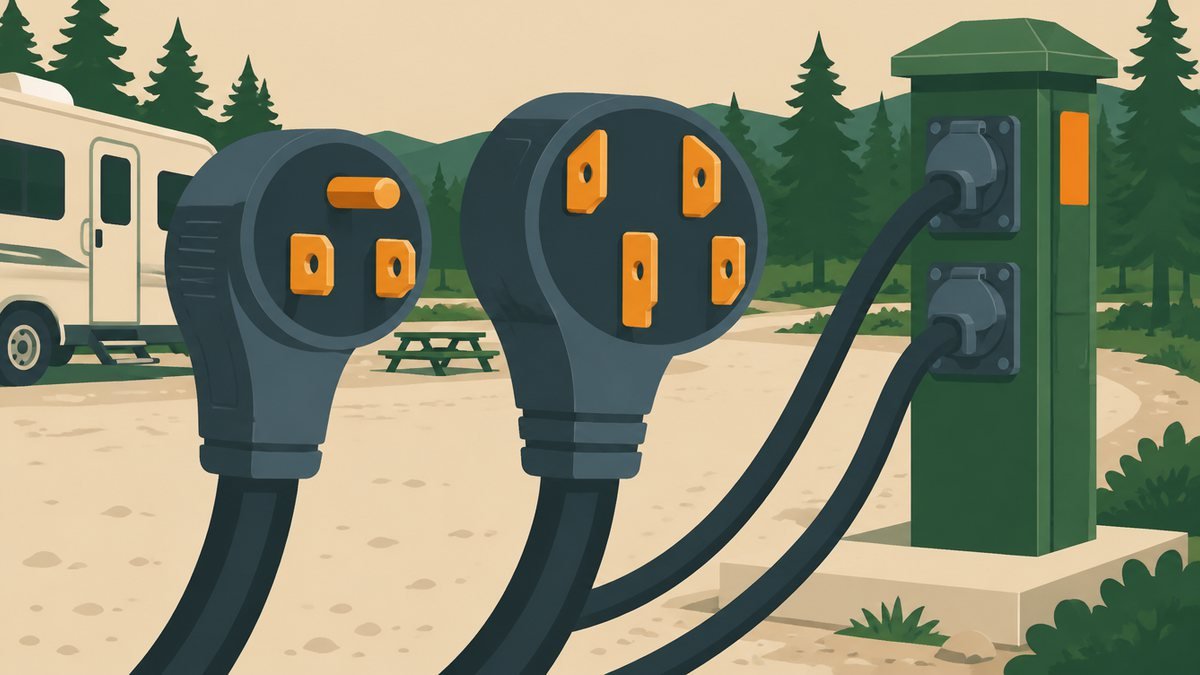
The 30 amp RV plug and the 50 amp RV plug look similar from a distance, but they’re different connections, deliver different amounts of power and can’t be swapped without an adapter. If you’re shopping for a power cord, plugging into an unfamiliar campground pedestal or wondering why the air conditioner trips the breaker, knowing the difference is the first step to staying safe and powered up.
This guide explains how 30 amp and 50 amp RV service work, how to tell the plugs apart, how adapters and cords fit into the picture, and how to avoid overloading your system.
30 amp vs 50 amp: the basics
RV shore power is alternating current (AC), the same kind as the outlets in a house. What differs between the two services is how much current they can carry and how many hot wires they use.
30 amp service
A 30 amp RV plug has three prongs: one hot wire, one neutral and one ground. It supplies a single 120-volt line, protected by a 30-amp breaker. Multiplying volts by amps gives a rough maximum of about 3,600 watts of power for everything in the RV combined. Many smaller trailers and campers are built for 30 amp service.
50 amp service
A 50 amp RV plug has four prongs: two hot wires, one neutral and one ground. It supplies two separate 120-volt lines (240 volts across both), each protected by a 50-amp breaker. That means each leg can carry up to 50 amps, for roughly 12,000 watts across the two legs in total. Larger RVs with multiple air conditioners, electric appliances and big power needs typically use 50 amp service.
That doesn’t mean a 50 amp RV gets “twice” the power of a 30 amp one: it can have more than three times as much total capacity, split between two circuits inside the RV. How the RV’s circuits are distributed on those two legs matters, and it’s why you can still overload a leg.
How to tell a 30 amp RV plug from a 50 amp plug
- Number of prongs: three for 30 amp, four for 50 amp.
- Size and shape: the 50 amp plug and cord are noticeably larger and heavier.
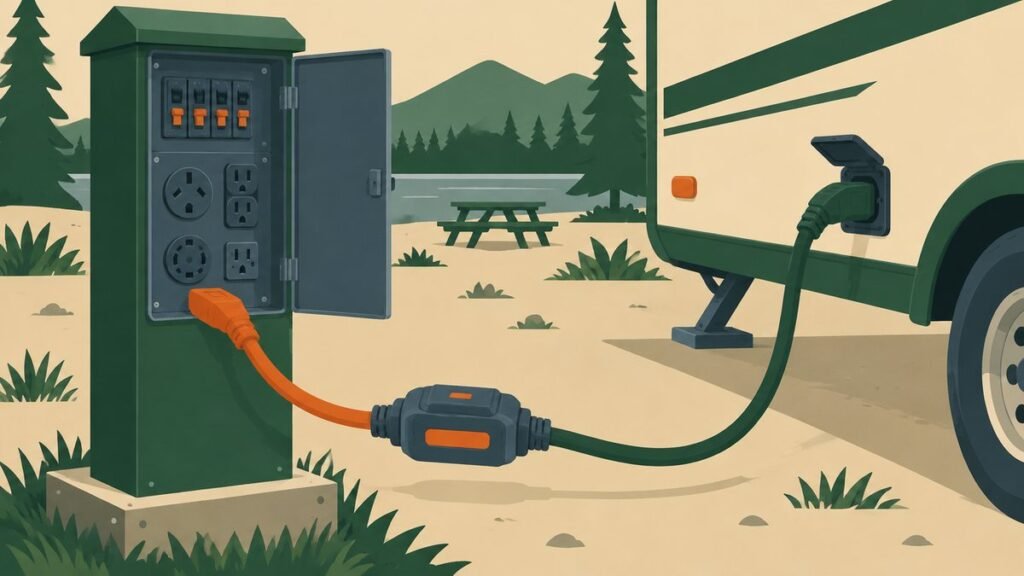
- Pedestal receptacles: campground pedestals usually have a 30 amp outlet (three holes), a 50 amp outlet (four holes), and sometimes a standard household 20 amp outlet. Each is protected by its own breaker.
- The cord: RV power cords are heavier-gauge than household extension cords, and they’re rated for the current they carry. Check the label.
If you aren’t sure which service your RV has, look at the plug on the power cord or the label near the power inlet, and check your manual.
Which service does your RV need?
The service type is built into your RV’s electrical system, and you can’t change it just by swapping plugs. A 30 amp RV has a 30 amp main breaker, wiring and a distribution panel built for that load. A 50 amp RV is wired for the larger system. Using adapters lets you connect to a pedestal of a different type, but your RV’s protection and wiring stay the same.
Adapters: connecting to a different pedestal
Adapters, often called dogbone adapters, let you connect to a pedestal that doesn’t match your plug.
- 30 amp RV to a 50 amp pedestal. A 50-to-30 amp adapter lets your three-prong plug connect to a four-hole outlet. Your RV still only draws what its 30 amp system allows, and the pedestal’s breaker protects the supply.
- 50 amp RV to a 30 amp pedestal. A 30-to-50 amp adapter lets you connect, but you’re limited to the power the 30 amp circuit provides, about 3,600 watts. You’ll need to manage loads carefully, because both legs of your RV are fed from the single 30 amp line.
- Either RV to a 20 amp household outlet. This provides much less power, and you’ll need to limit what you run.
Use adapters rated for the full current, and keep them in good condition. A loose or overheated adapter is a common cause of melted plugs. Don’t daisy-chain multiple adapters or use household extension cords.
Choosing an RV power cord
- Match the amperage rating to your RV: 30 amp or 50 amp.
- Check the length. Longer cords have more voltage drop, which can strain appliances. Use the shortest cord that reaches comfortably.
- Look for the right wire gauge, as a thicker wire carries more current safely.
- Choose a cord with quality ends, a strain relief and a weather-resistant jacket. Some have lighted ends that show when power is present.
- Consider a cord with a locking or twist-lock end, which helps keep a secure connection.
A 50 amp RV cord is heavy and stiff; a 30 amp one is lighter and easier to manage. Either way, inspect your cord for cuts, burns, discolored pins and cracked jackets before each trip, and replace damaged ones.
How to avoid overloading your RV’s power
Watts equal volts times amps, so you can estimate what you can run. On 30 amp service, the budget is roughly 3,600 watts across everything, and an air conditioner can use a large share of it. Here’s how to manage it.
- Know your big loads. Air conditioners, electric water heaters, microwaves, space heaters, hair dryers and induction cooktops draw the most.
- Stagger use. Run one big appliance at a time on a 30 amp service.
- Watch for warning signs. Lights dimming, breakers tripping or an air conditioner struggling can mean you’re near the limit.
- Use a power management system or energy monitor if you need help balancing loads.
Protecting your RV: surge protection and monitoring
Campground power can be unreliable: low voltage, high voltage, miswired pedestals and surges can damage electronics and appliances. A surge protector or an electrical management system (EMS) goes between the pedestal and the RV, and can shut off power when it senses a problem such as reversed polarity, an open ground or voltage out of range. Look for a unit matched to your RV’s amperage.
Check the pedestal outlet and your cord before plugging in. A quick tester can show whether the outlet is wired correctly. Our RV battery charger guide explains what happens when shore power reaches the converter.
Generators and shore power
If you use a generator, make sure its output matches the plug type your RV needs, and that you connect it properly. See our guide to RV generators for choosing and sizing them for 30 amp and 50 amp RVs.
Common problems
- Breaker keeps tripping. You may be overloading the circuit; try reducing loads. Check for a failing appliance or a loose connection.
- Melted or discolored plug or outlet. A loose connection, worn plug or damaged pedestal can overheat. Stop using it, and ask the campground to repair the pedestal.
- Power on one side of a 50 amp RV only. One leg may have a problem at the pedestal, adapter or cord.
- Tingling when touching metal. This could be a ground fault. Disconnect shore power and have it inspected right away.
Safety notes
RV shore power is high voltage and high current, and can cause fire and electrocution. Always turn off the pedestal breaker before plugging or unplugging when possible, and keep plugs dry and fully inserted. Don’t use damaged cords or adapters, and never modify plugs or defeat the ground prong. Don’t overload extension cords. For repairs to wiring, the power inlet or the RV’s panel, call a qualified RV technician or electrician.
If you’re wondering whether your electrical service can handle laundry, see our guide to the RV washer dryer combo.
Frequently asked questions
Can I plug a 50 amp RV into a 30 amp outlet?
Yes, with the proper adapter, but you’ll only have 30 amp capacity, so you’ll need to manage loads.
Can I plug a 30 amp RV into a 50 amp outlet?
Yes, with an adapter. Your RV’s wiring and breaker still limit the current to 30 amps.
How many amps does an RV air conditioner use?
It varies by model, and the startup surge is higher than the running draw. Check the label on your unit and the owner’s manual.
Do I need a surge protector?
It’s strongly recommended. Campground power varies, and a protector or EMS can prevent costly damage.
Sources
These public agencies and standards organizations publish guidance that is a good place to confirm the details on this topic.