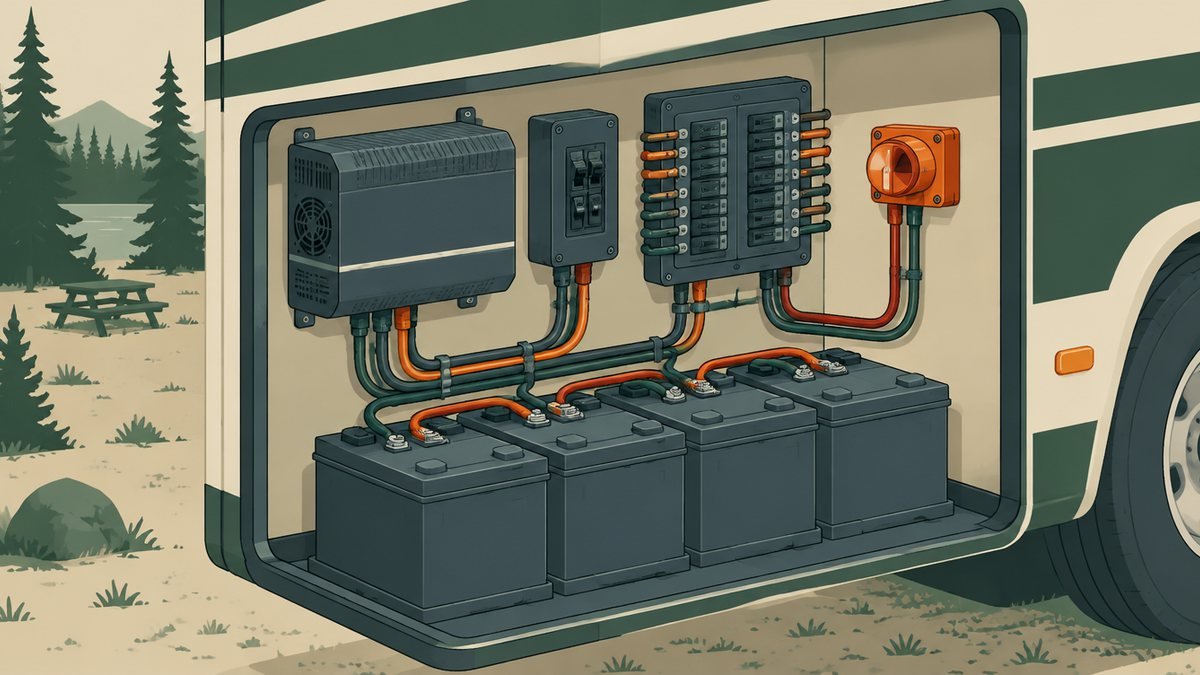
An RV battery charger keeps your house batteries full when you’re plugged in, and a battery disconnect switch lets you cut power to the 12-volt system when you’re not using it. Together they protect your batteries, prevent a dead-battery surprise, and make storage and maintenance safer. Yet many owners don’t know which charger their RV actually has, or what the disconnect really isolates.
This guide explains how RV battery charging works, the types of chargers you’ll run into, what a battery disconnect switch does, and how to use both properly.
The RV solar and battery calculator also shows the charge current your solar controller will see.
How an RV battery charger works
An RV has several ways to charge its house batteries:
- The converter-charger. Built into most RVs, it converts 120-volt shore power or generator power into 12-volt DC to run your lights and charge the batteries.
- The tow vehicle or engine alternator. While driving, the alternator can charge your batteries through a charge line, or through a battery isolator in a motorhome.
- Solar panels. A solar charge controller regulates the power from panels into the batteries.
- A separate plug-in battery charger. A portable or permanently installed charger you connect to the battery directly.
Whatever the source, a good battery charger follows a charging profile with several stages, so the battery charges quickly at first and then tapers to avoid overcharging.
Charging stages explained
Most modern multi-stage chargers use some version of these steps:
- Bulk. The charger delivers its maximum current until the battery reaches a set voltage. This is where most of the energy goes in.
- Absorption. Voltage is held steady while current tapers off, topping up the remaining capacity.
- Float. Voltage drops to a lower level to keep the battery full without overcharging it.
- Storage or maintenance mode. Some chargers have a mode that slightly lowers voltage for long-term storage.
Different battery chemistries need different voltages and stages. A charger set for flooded lead-acid batteries isn’t automatically right for AGM or lithium. See our guide to the deep cycle RV battery for how each type charges, and always match the charge profile to your battery.
Types of RV battery chargers
Converter-charger
This is the box in your RV that handles shore power. Older converters are simple and may use a single voltage that can slowly overcharge a battery or leave it undercharged. Newer converters have multi-stage charging and sometimes a lithium profile. If your RV is older, upgrading the converter-charger is one of the best improvements for battery life.
Portable or bench chargers
A battery charger for RV battery use that you connect directly to the terminals is useful for storage, for topping up a battery before a trip, or for charging a battery removed from the RV. Smart chargers can detect the battery type and adjust automatically on some models.
Battery maintainers
A maintainer, sometimes called a trickle charger, provides a very small current to keep a battery from self-discharging during storage. It’s not intended to recharge a deeply discharged battery quickly.
DC-to-DC chargers
These sit between the tow vehicle or alternator and your house battery and manage how the battery is charged from the vehicle. They are especially helpful with lithium batteries or long wire runs.
Choosing the right RV battery charger
- Match the chemistry. Confirm the charger supports your battery type: flooded, AGM or lithium.
- Size the current. A larger charger charges faster, but each battery has a maximum recommended charge current. Check the battery manufacturer’s specifications.
- Look for multiple stages and temperature compensation, which help protect the battery in hot or cold conditions.
- Check safety features, such as reverse polarity protection, short-circuit protection and overheat protection.
- Consider where you’ll use it. A fixed converter is convenient; a portable charger is flexible.
What an RV battery disconnect switch does
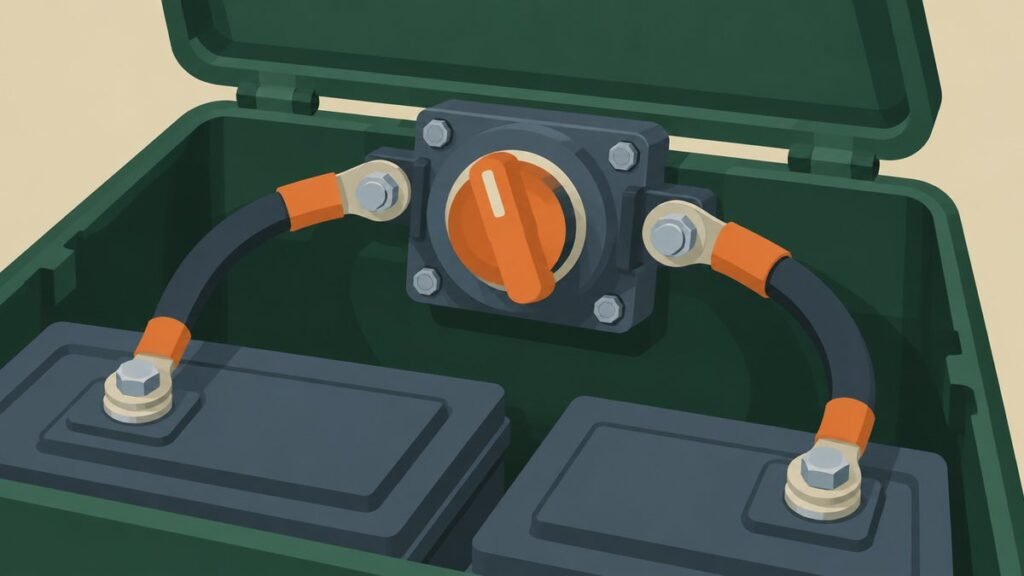
A battery disconnect switch is a heavy-duty switch, often a rotary knob or a lever, that interrupts the battery’s connection to the RV. With the switch off, 12-volt loads that would otherwise drain the battery are cut off. Typical items that draw power even when the RV is “off” include the propane leak detector, the refrigerator control board, stereo memory, clocks and some monitor panels.
Why use one
- Storage. Disconnecting the batteries keeps small parasitic loads from slowly draining them.
- Safety during work. Turning off the battery removes power before you work on 12-volt wiring.
- Theft and mishap protection. It makes it harder for the system to be used or drained unintentionally.
What the switch might not disconnect
Some RVs have more than one battery or more than one switch, such as separate switches for the house and chassis batteries in a motorhome. Some loads may be wired directly to the battery and bypass the switch. Check your RV’s wiring diagram or manual so you know exactly what turning the switch off disconnects, and don’t assume the whole RV is isolated.
Important caution with charging
If you switch off the battery disconnect while a charger or solar panel is connected, you may stop charging or, in some systems, create a risk of voltage spikes. Check the recommendations for your equipment. Lithium batteries and sensitive electronics, in particular, can be damaged by a charger or alternator that’s connected to an open circuit.
Using your charger and disconnect together
- Before storage: fully charge the batteries, then turn off the disconnect. Use a maintainer or leave the charger connected only if it is designed for long-term float and your manual allows it.
- During camping: leave the disconnect on, and make sure the converter-charger or generator is charging when you’re connected. Our guide on RV generators covers how they charge the bank.
- Before working on 12-volt wiring: turn off the disconnect first, and unplug shore power.
- After storage: turn the disconnect on and check battery voltage before relying on the system.
Common problems
- Battery won’t hold a charge. It may be old, sulfated or damaged, or something is draining it. Test the battery under load and check for parasitic draws.
- Charger runs constantly or gets hot. It may not be matched to the battery, or it may be failing.
- Lights dim or flicker on shore power. A failing converter, a poor shore power connection or low voltage at the pedestal could be the cause. See our 30 amp RV plug guide for more on shore power connections.
- Battery drained overnight. Look for loads that stay on, a failing refrigerator board or a short.
Safety notes
Charging produces heat and, with lead-acid batteries, flammable hydrogen gas. Charge in a ventilated area and keep sparks and flames away. Disconnect shore power before working on the converter, and never open a charger or converter while it’s plugged in. Wear eye protection when working near batteries, remove metal jewelry, and use insulated tools. Don’t charge a frozen or damaged battery. For anything involving 120-volt wiring or a suspected short, call a qualified RV technician.
Frequently asked questions
Can I leave my RV plugged in all the time?
Many RVs with a modern multi-stage converter can stay plugged in. With an older converter, the batteries may be overcharged over time. Check your converter and battery types, and consider a battery monitor.
Do I need a disconnect switch if I have a battery maintainer?
They do different jobs. A maintainer keeps the battery topped up; a disconnect stops parasitic drain. Many owners use both during storage.
Why does my battery keep dying in storage?
Parasitic loads, an aging battery, or an undersized maintainer are the usual causes. Turn off the disconnect, fully charge the battery, and have it tested.
Can I use a car battery charger on an RV battery?
Sometimes, if the charger supports your battery type and settings. Check the battery maker’s requirements first, especially for AGM and lithium.
Sources
These standards organizations and industry groups publish guidance that is a good place to confirm the details on this topic.