
An RV water softener removes the minerals that make water “hard”, and whether you need one depends on where you camp and how long you stay. Hard water leaves white scale on faucets and shower doors, makes soap harder to lather and can build up inside your water heater and plumbing. A softener can help with all of this, but it adds cost, bulk and a chore or two, so it isn’t worth it for every RV owner.
This guide explains what hard water is, how an RV water softener works, who benefits from one, and how to set one up and use it properly.
What is hard water?
Hard water contains dissolved calcium and magnesium. These minerals come from the rock and soil that water passes through, so water hardness varies a lot from region to region and even from one campground to the next. Hardness is usually measured in grains per gallon (gpg) or in parts per million (ppm), and many water test strips and meters let you check it quickly.
Hard water isn’t generally a health problem. Its effects are mostly on your equipment and your comfort:
- Scale buildup on faucets, showerheads, tank walls and inside the water heater.
- Spots and film on dishes, glass and the RV’s shower.
- Dry skin or hair for some people, and soap that doesn’t lather well.
- Reduced efficiency if scale insulates heating elements and tanks.
How an RV water softener works
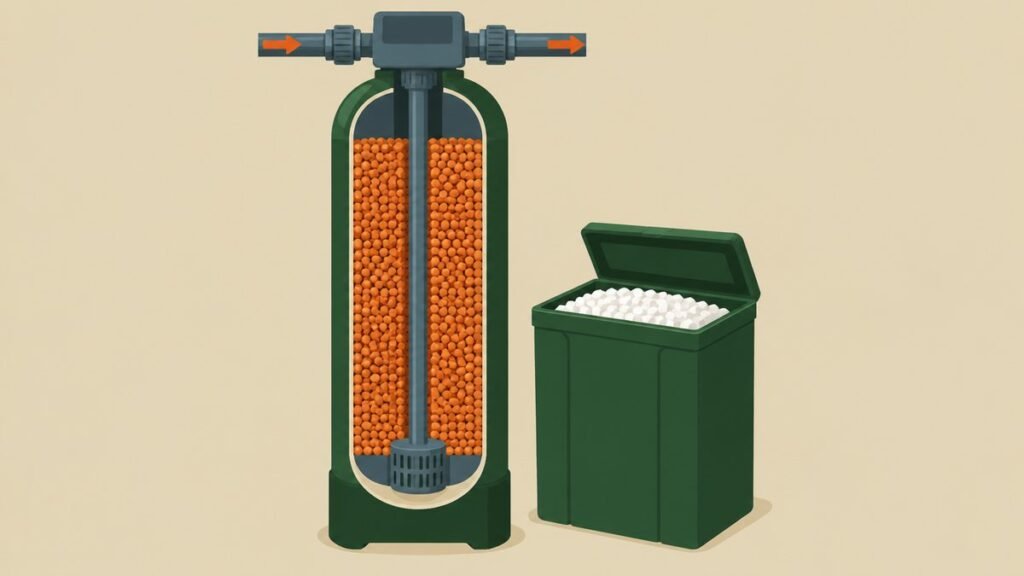
Most portable and RV water softeners work by ion exchange. Water passes through a tank filled with tiny resin beads that hold sodium (or sometimes potassium) ions. As hard water flows over the beads, calcium and magnesium swap places with the sodium and stay on the resin, while softer water flows out.
Over time, the resin fills up with calcium and magnesium and stops softening. This is called exhaustion. To restore it, the resin has to be regenerated: a salt solution (brine) is passed through the tank, which flushes the hardness minerals out and recharges the beads with sodium. Most portable RV softeners are regenerated manually, while larger units may have automatic controls.
Do you need a water softener in your RV?
A softener is more helpful if
- You camp for long periods in areas with very hard water, or you’re a full-timer.
- You notice heavy scale on fixtures, shower walls and the water heater.
- You rely on an electric water heater element or a tankless heater that scales easily.
- You want softer-feeling water for showering and washing.
You might skip it if
- You camp mostly in areas with soft or moderate water.
- You travel often, and setting up and regenerating a softener at each stop is a nuisance.
- You don’t have space to store and transport it.
- You mostly use the fresh tank rather than city water.
If you’re not sure, test your water at the campground. A basic hardness test strip takes a minute and tells you whether scale is likely to be a problem.
Types of RV water softeners
Portable ion exchange softener
The most common option for RVs. A cylindrical tank filled with resin sits outside the RV between the spigot and the hose, or between the filters and the RV. They come in different capacities, measured in grains of hardness the resin can remove before it needs regenerating. A larger capacity means longer between regenerations, but a bigger, heavier tank.
Built-in or larger softener systems
Some RVs and park models use a larger system installed permanently, with automatic regeneration. They’re more convenient but more expensive and involve plumbing work.
Descalers and conditioners
Some devices don’t remove minerals but claim to change how scale forms. The results are debated, and they generally aren’t the same as a softener, so look for independent testing before relying on one.
How to set up an RV water softener
Always follow the manufacturer’s instructions. A typical setup works like this:
- Place the softener on level ground in the shade, close to the spigot, with the arrow pointing in the direction of flow.
- Connect it after the regulator and, if you use one, a sediment filter, so grit doesn’t clog the resin. See our guide on the RV water pressure regulator for the usual hookup order.
- Rinse the resin by running water through it as the instructions say, until the water is clear.
- Connect the hose to the RV.
- Check the hardness of the water coming out. Some softeners include a test strip for this.
- Keep track of how much water you’ve used, so you know when to regenerate.
How to regenerate your softener
Regenerating means flushing the resin with a salt brine to restore it. The general process is:
- Turn off the water and disconnect the softener.
- Fill the tank with water and the recommended amount and type of salt, or use the process the manufacturer outlines, such as soaking the resin in brine.
- Let it sit for the recommended time.
- Rinse thoroughly until the water runs fresh and not salty.
- Reconnect it and check for leaks.
Use only the type of salt the manufacturer recommends. Some use coarse softener salt, and others specify a different form. Regenerating at a campground requires a place to dispose of the brine, and many campgrounds don’t allow it. Follow campground rules, or regenerate at home.
Softener, filter and regulator: the order
A common arrangement from the spigot is regulator, sediment filter, softener, carbon filter, then the hose to the RV, but check each product’s instructions because requirements vary. Some resins can be damaged by chlorine, and sediment can clog them, so the order matters. Our guide to the RV water filter explains the options.
Softened water: things to know
- It tastes and feels different. Soft water can feel slippery and has a small amount of sodium added. If you’re watching your sodium intake, ask a health professional, and consider keeping a separate source for drinking.
- It may change how you use soap. You often need less.
- It can speed anode rod wear. Some owners with softened water find their water heater’s anode rod needs checking more often. See our guide to the RV water heater anode rod.
- It doesn’t clean the water. A softener isn’t a substitute for a filter.
Maintenance and storage
- Keep the resin from drying out. Store the softener sealed and upright, with a little water inside.
- Protect it from freezing, since the tank can crack.
- Replace the resin when it no longer softens, even after regenerating.
- Check hoses, seals and fittings regularly.
- Keep the salt dry and sealed.
Safety notes
A full softener tank is heavy, so lift carefully. Don’t drink water from a system that hasn’t been rinsed after regenerating. Keep salt away from children and pets, and dispose of brine according to campground and local rules. If anyone in your household has a medical condition that restricts sodium, check with a doctor about softened water.
Frequently asked questions
How long does an RV water softener last between regenerations?
It depends on the capacity of the unit and how hard your water is. The harder the water, the faster it runs out. Test your water and follow the manufacturer’s capacity guidelines.
Can I use a water softener with a filter?
Yes, and many owners do. Sediment filters usually go before the softener to protect the resin.
Will a softener remove odors or chlorine?
Not typically. A carbon filter handles those, while a softener deals with hardness.
Is softened water safe to drink?
It’s generally safe, but it contains a small amount of added sodium. If you’re on a restricted-sodium diet, ask your doctor.
Sources
For your exact model, the manufacturer’s documentation is the authority. These sources are good places to start.