
An RV washer dryer combo promises the dream of doing laundry without leaving your rig: no laundromat trips, no quarters, no sitting around. But it’s a big commitment of space, weight, water and power, and a combo unit isn’t the same as the full-size machines at home. Whether it’s worth it depends on how you camp, how much laundry you generate and what your RV can support.
This guide explains how RV washer-dryer combos work, what they need to operate, their pros and cons and the questions to ask before you install one.
What is an RV washer dryer combo?
A washer dryer combo is a single machine that both washes and dries clothes in the same drum. You load the laundry, run a wash cycle and, when it’s finished, the same drum dries the load. This saves space compared with having two separate machines, which matters in an RV where every inch counts.
There are also separate compact washers and dryers, sometimes designed to be stacked. A stackable washer and dryer set handles larger loads at the same time, though it takes more space and weight. Many RV owners also use a compact washer only and dry clothes on a line or at a laundromat.
How a combo unit dries clothes
Most combo units are designed to work without an outside vent. Instead of blowing hot, moist air out through a duct, they use a condensing method. Hot air passes through the damp clothes, and the moisture is then cooled and condensed into water, which drains away. Some models use a heat pump to do this more efficiently. A few models can be vented to the outside.
Because the process is more gradual than a vented dryer, drying takes longer. A load of laundry may take a few hours to dry, depending on the machine, the load and the settings. It’s normal for the cycle to take much longer than a household vented dryer.
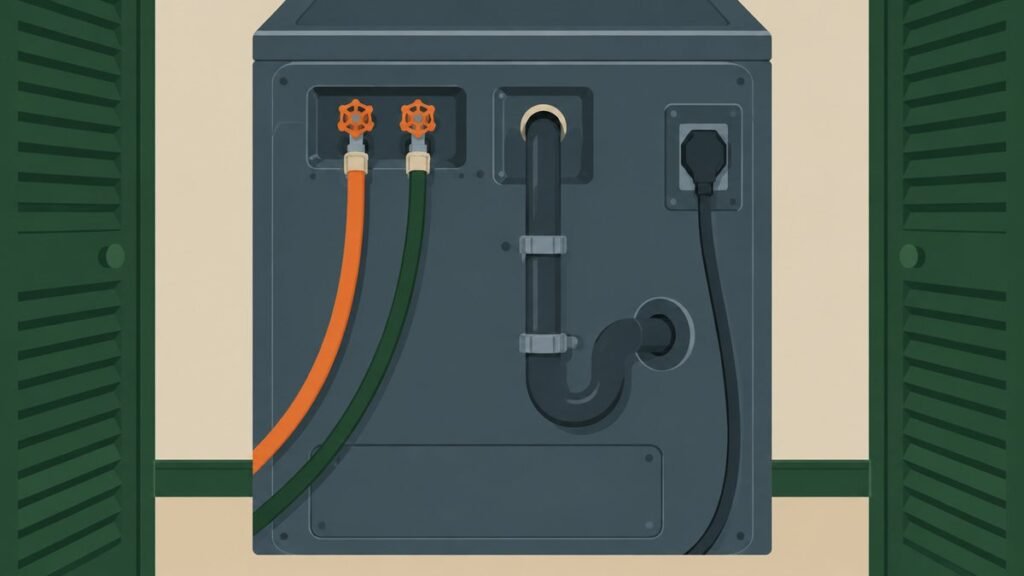
What an RV washer dryer combo needs
Space and weight
Combos are compact, but they’re heavy, especially when full of water and wet laundry. Check the weight and your RV’s cargo capacity, and make sure the floor and mounting location can handle it. Many RVs that are prepped for a washer-dryer have a closet with the right connections and structural support; others need modifications. Keep the weight in mind when loading the RV and balancing it.
Water supply
You need hot and cold water connections, or at least a cold connection depending on the model, with shutoff valves. The unit uses water on every wash, so a good supply is important. On a long boondocking trip, laundry can empty your fresh tank quickly. If you rely on the tank, your pump has to keep up. Our guide to the RV water pump explains how to make sure it can.
Drainage
The washer discharges gray water, often a lot of it in a short time. It needs a proper drain connection, usually to the gray tank, with a trap to block odors. A gray tank can fill fast with laundry, so plan how you’ll dump it, whether at a sewer hookup or with a portable tank. See our guide to the RV portable waste tank.
Electrical power
A washer dryer combo runs on 120-volt power, and the dryer function, in particular, uses a lot of electricity. Check the wattage and the amperage on the label. On 30 amp service, running the dryer with the air conditioner and other large loads may overload the circuit, so you may need to manage what’s running. Generators and inverters need enough capacity to start and run it. See our guide to 30 amp RV plugs for how service limits work.
Ventilation
Even ventless models release some heat and humidity into the RV. Provide airflow in the area and make sure the unit has the clearance the manufacturer specifies. Some owners use a roof vent or window to move air. Models that vent outside need a duct to the outside.
Pros and cons
Advantages
- Convenience. Laundry on your own schedule, anywhere you have hookups.
- Saves time and money compared with laundromats over a long stay.
- One machine instead of two, saving space.
- Good for full-timers and long-term travelers.
Drawbacks
- Small capacity. Loads are smaller than at home, and bulky items such as bedding may not fit.
- Long cycles. Washing and drying a load can take several hours.
- High water and power use. It can strain tanks, pumps, generators and shore power.
- Weight and space. It takes up a closet and adds a lot of weight.
- Cost. Units and installation can be expensive.
- Maintenance. Lint, detergent residue and moisture need attention to avoid odors and damage.
- Drying performance. Combos may leave clothes slightly damp, and some owners use the dryer for finishing only.
Is it worth it for you?
A combo may suit you if you:
- Travel full-time or for long stretches and do laundry regularly.
- Stay at sites with full hookups most of the time.
- Have a space and plumbing designed for it, or a good reason to modify.
- Accept the long cycles and small loads.
It may not be worth it if you:
- Camp mostly off-grid, with limited water and power.
- Take short trips and can wash at home.
- Are limited by your RV’s weight capacity or space.
- Prefer to do large loads in one go.
Tips for choosing a combo
- Check dimensions and weight against the space and your RV’s capacity.
- Check the power requirements and make sure your system can handle them.
- Look at water use per cycle. Efficient models save water.
- Consider noise and vibration, since the unit sits close to living space.
- Check whether it’s rated for mobile use or has a transit lock for the drum if you plan to travel with it installed.
- Look at the manufacturer’s installation requirements for hookups, drains and clearance.
Using a washer dryer combo in an RV
- Use the right detergent, usually high-efficiency (HE), in the amount recommended, since too much creates excess suds.
- Don’t overload the drum.
- Level the RV before running a load, to prevent vibration and wear.
- Run the drain cycle into a proper outlet and watch your gray tank level.
- Clean the lint filter and the door seal regularly, and leave the door ajar between uses to prevent odors.
- Wipe up moisture and keep the closet ventilated.
Winterizing and storage
Water left in the machine’s lines, pump and drain can freeze and crack parts. The washer needs its own winterizing steps, which differ from the rest of your plumbing. Check the manufacturer’s instructions, and don’t assume that pumping antifreeze through the RV’s lines handles it. Our guide on how to winterize an RV covers the system, and the RV winterizing kit guide helps with the parts.
Common problems
- Clothes aren’t completely dry. Reduce the load, run a second dry cycle or use the machine for partial drying, followed by line drying.
- The machine shakes or walks. An unbalanced load or an unlevel RV; also check the transit locks and mounting.
- Bad odors. Detergent residue and moisture build up. Clean the drum, door seal and drain, and leave the door open.
- Water leaks. Check the hoses, fittings and drain connection.
- Breaker trips. The combined load may exceed your service. Run it alone.
Safety notes
The machine’s dryer function produces heat and moisture, and lint can burn, so keep the lint filter clean and the area free of anything flammable. Make sure the electrical circuit is properly rated and that the installation follows the manufacturer’s instructions and local codes. Have a qualified RV technician install plumbing and wiring if you aren’t confident. Don’t run the washer unattended when the RV is unlevel, and secure the unit for travel, as the manufacturer directs.
Frequently asked questions
Does an RV washer dryer combo need a vent?
Many are ventless condensing models that don’t need an outside vent, though they still release heat and humidity. Some can be vented. Check the specific model.
How long does a combo take to wash and dry a load?
It varies by model and load, but the full cycle usually takes a few hours, much longer than a household washer and dryer.
Can I run a washer dryer combo on a generator?
Possibly, if the generator can handle the startup and running load, especially when the dryer’s heating element is on. Check the unit’s power ratings and your generator’s capacity.
Can I add a washer dryer to an RV that wasn’t built for it?
Sometimes, but it needs space, water, a drain, power and structural support. A qualified RV technician can advise.
Sources
These public agencies and standards organizations publish guidance that is a good place to confirm the details on this topic.