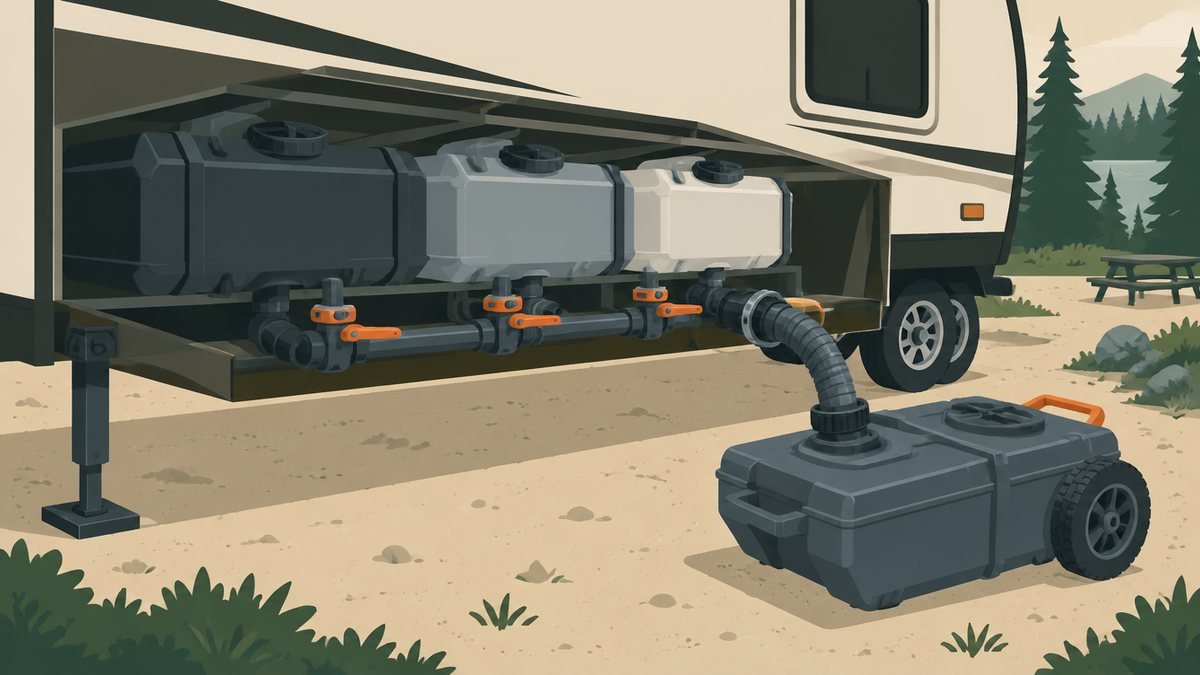
Your RV has three kinds of tanks: fresh water, gray water and black water. Fresh water comes in, and gray and black water go out. Understanding what each tank holds, how the valves and sensors work, and when and how to empty them saves you from the most unpleasant RV problems, from smelly bathrooms to clogged tanks and false sensor readings. And when you need to empty a tank away from a sewer connection, an RV portable waste tank, often called a tote or blue boy, is the tool for the job.
This guide explains the built-in tanks, how a portable RV waste tank fits in, and the right way to dump and care for them.
The three RV tanks
Fresh water tank
The fresh tank holds drinking and washing water. A pump draws from it to supply your faucets when you aren’t connected to city water. Keep this tank clean and sanitized; our guide on how to sanitize an RV fresh water tank explains how.
Gray water tank
The gray tank collects water from sinks and the shower. It’s called gray because it contains soap, food particles, hair and grease, but not toilet waste. Gray water can still smell, since it can develop bacteria and trap food debris.
Black water tank
The black tank holds waste from the toilet, along with the water used to flush. It needs to be treated and emptied carefully. Many RVs have one gray tank and one black tank; some larger rigs have more than one of each.
Each tank connects to the sewer outlet through a termination valve, also called a dump valve, usually a gate valve operated by a handle or knob. Many RVs have two handles, one for black and one for gray, and some have a third for a second gray tank.
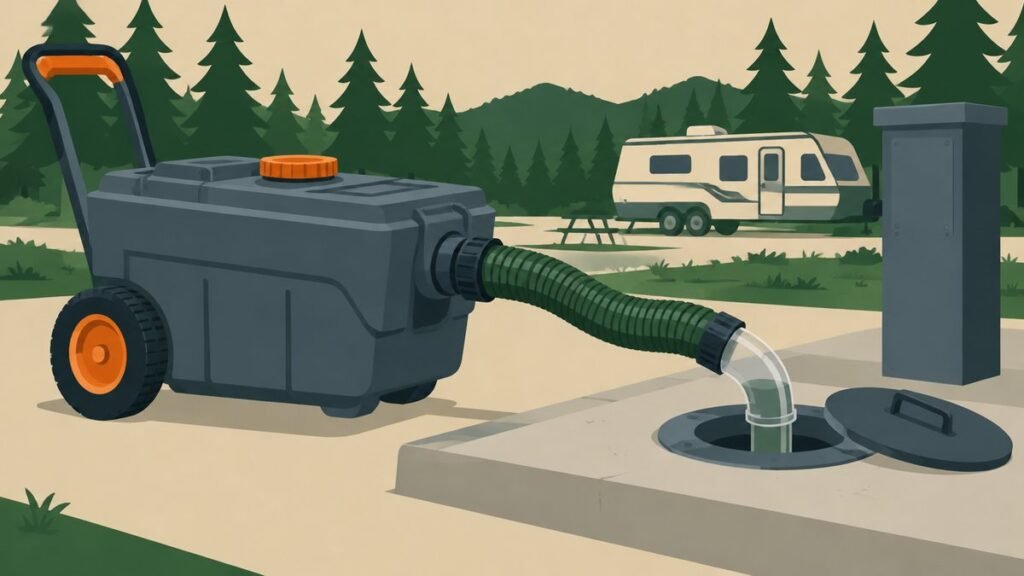
What is an RV portable waste tank?
A portable waste tank, sometimes called a tote tank or portable holding tank, is a wheeled tank that you connect to your RV’s termination valve, fill with waste, then pull to a dump station or approved disposal point. It’s useful when you’re camped at a site with no sewer hookup, when the sewer connection is far away or when you need to empty your tanks without moving the RV.
Features of a portable waste tank
- Wheels and a handle, so you can tow it by hand or with a vehicle at low speeds, if it’s designed for that.
- A fill and drain fitting, with a valve to control flow.
- A vent, which lets air out as the tank fills and in as it empties.
- Capacity in gallons. Common sizes are small enough to move by hand. Make sure you know how much the tank holds when full and how heavy it is, because liquid waste is heavy.
- A sturdy construction that resists cracking, UV damage and leaks.
When a portable tank makes sense
- Long stays at campsites without a sewer connection.
- Dispersed camping near a dump station or a place to dispose of waste legally.
- Large RVs that can’t be moved easily.
- Emptying the tanks before travel without breaking camp.
How to use a portable waste tank
- Place the tote on level ground, as close to the RV outlet as practical.
- Wear gloves, and have a sewer hose with a bayonet or threaded fitting, and a clear elbow if you like to see the flow.
- Connect the sewer hose to the RV’s outlet and the tote’s inlet, securely and with fittings sealed.
- Open the black tank valve first, let it empty, then close it. Then open the gray tank to flush the hose.
- Close the RV valves. Disconnect the hose, keeping the end elevated so contents drain into the tote.
- Close the tote’s inlet and secure the cap before moving it.
- Transport the tote carefully to an approved dump station, and don’t overfill it.
How to empty RV tanks at a dump station
- Wear disposable gloves and keep dedicated hoses for sewage.
- Connect the sewer hose to the RV outlet first, then to the dump station inlet, making sure it’s sealed.
- Empty the black tank first, by opening its valve fully, and let it drain completely.
- Close the black valve, then open the gray valve to rinse the hose.
- Close both valves, rinse the hose with the provided non-potable water, and store it properly.
- Wash your hands thoroughly afterward.
Many owners wait until the black tank is about two-thirds full before dumping, since this gives enough liquid to carry solids out. Leaving the black tank valve open while connected to a sewer is not recommended, because liquids drain away and solids can build up.
Keeping tanks clean and odor-free
- Use enough water when flushing the toilet, so solids move into the tank and don’t dry out.
- Use RV toilet paper or very little regular paper, and don’t flush wipes. See our guide on RV toilets for more tips.
- Use a tank treatment if you like. Many owners use treatments that help break down waste and control odors.
- Flush the tanks using a built-in tank rinse, or an external flushing wand, after emptying.
- Add water to the gray tank and a little soap if it smells, then dump again.
- Keep vents clear. The roof plumbing vent lets air into the tank so it drains smoothly. A blocked vent can cause gurgling and slow drains.
Common tank problems
Sensors show wrong levels
Tank sensors can get coated with grease, soap or debris, so they read “full” when the tank isn’t. Flushing and using a sensor-cleaning treatment can help. Some owners use a high-pressure flush or a tank wand to clean the walls.
Slow or clogged drains
Causes include debris, a vent blockage, a kinked hose or a built-up pile of solids in the black tank. Using enough water and treatment, and not flushing the wrong items, prevents most clogs.
Smells inside the RV
The usual causes are a dry P-trap in a sink or shower drain, a leaking toilet seal, a vent problem or a tank that needs cleaning. See our RV toilet valve repair guide if the problem is the toilet seal.
Valve won’t open or close fully
Dump valves can stick or leak when they’re dirty or worn. Clean the seals and lubricate them if the manufacturer allows, or replace the valve if it’s damaged.
Freezing
Tanks and valves can freeze in cold weather. Protect them with heated tank pads, an enclosed underbelly or by keeping them from filling when freezing is a risk. Avoid putting RV antifreeze in the tanks unless your manual recommends it. See our guide on how to winterize an RV.
Safety and sanitation
Wastewater contains bacteria and other hazards. Wear gloves and wash your hands afterward. Dump only at approved dump stations, and never onto the ground or into storm drains. Keep sewer hoses and fittings separate from drinking water hoses and equipment. Follow the rules of the campground and local law for portable tank disposal. Don’t mix chemicals, and keep treatments away from children and pets. Be careful with the weight of a full portable tank, because it can tip or run away on a slope.
Frequently asked questions
How often should I empty my RV tanks?
When the black tank is about two-thirds full or as needed, and sooner if the gray tank is full. It depends on how many people use the RV and how you camp.
Can I leave the gray tank valve open?
Some owners do when connected to a sewer, but many close it until the tank is partly full so water flushes the line. The black tank valve should stay closed until you dump.
What size portable waste tank do I need?
Choose a size that you can move safely when full. Larger tanks hold more but are heavy, so think about how and where you’ll tow or carry it.
Can I dump a portable tank anywhere?
No. Use an approved dump station or disposal point. Dumping waste elsewhere is illegal in most places.
Sources
For your exact model, the manufacturer’s documentation is the authority. These sources are good places to start.