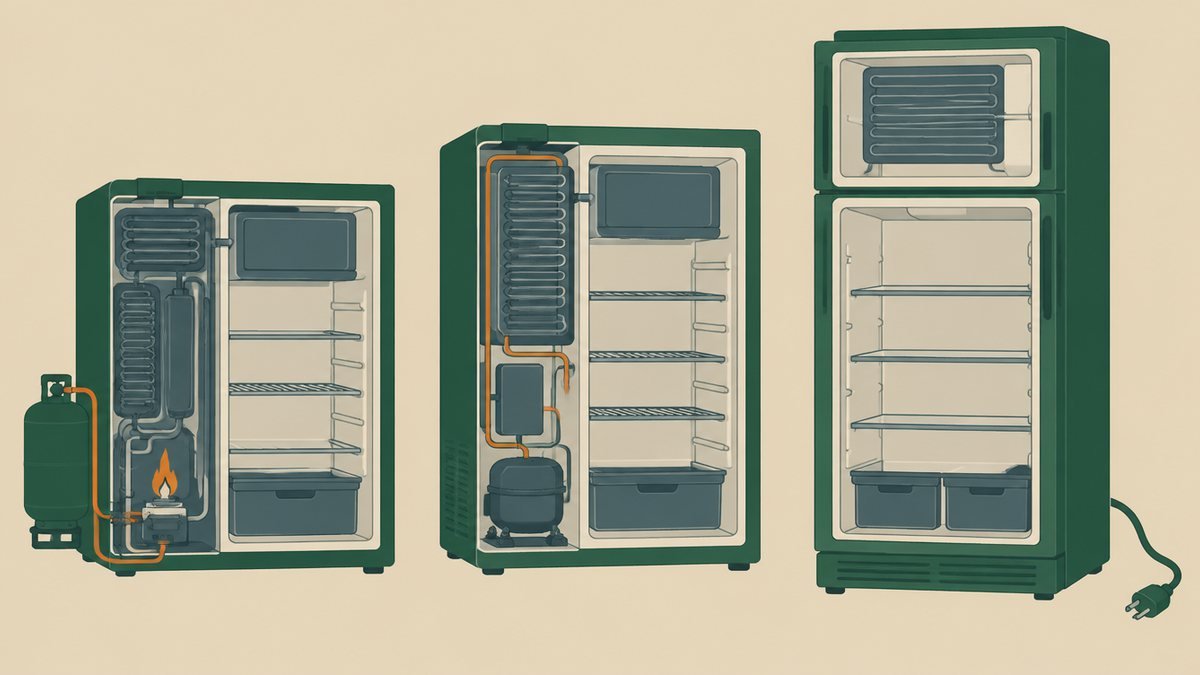
If you’re shopping for a 12 volt RV refrigerator, or trying to decide whether the one you have is the right type, the first thing to know is that “RV refrigerator” covers three quite different technologies. Each one cools in a different way, runs on different power and behaves differently when you’re boondocking, parked at a campground or driving down the road. Choosing the wrong type for how you camp is the most common source of regret.
This guide explains the three main RV refrigerator types, absorption, 12-volt compressor and residential, how each one works, what they need to run, and who each one suits.
The three types of RV refrigerators
- Absorption refrigerators use heat, from propane or electricity, to drive a cooling cycle. They have no compressor.
- 12-volt compressor refrigerators work like a household fridge, using a compressor powered by the RV’s battery system.
- Residential refrigerators are standard household units that run on 120-volt AC power, usually with an inverter or shore power.
Absorption RV refrigerators
An absorption refrigerator is the traditional RV fridge. A heat source, a propane burner or an electric heating element, drives a sealed cycle of ammonia, water and hydrogen that absorbs heat inside the cabinet and releases it through cooling fins at the back, which vent outdoors.
Power sources
Most absorption models run on two or three sources: propane, 120-volt AC and sometimes 12-volt DC. That is why an RV propane refrigerator is often called a “gas and electric” or “two-way” fridge. Many can switch automatically between sources.
Advantages
- Runs without any electricity when on propane, which is ideal for boondocking.
- Silent, with no compressor noise.
- No moving parts in the cooling system.
- Works while traveling on propane or 12 volts, as local rules and your manual allow.
Drawbacks
- Must be level to work properly, within the limits in the manual.
- Slow to cool, and less effective in very hot weather, especially without good venting around the cooling unit.
- Uses propane and requires safe operation of an open flame in a vented compartment.
- The sealed cooling unit isn’t repairable in the field if it fails.
If your RV has one, our guide to RV refrigerator repair covers the common causes of poor cooling.

The 12-volt RV refrigerator: how compressor models work
A 12v RV refrigerator of this type uses a compressor and refrigerant, just like a home fridge, but powered by 12-volt DC from the house battery. Many models also include an AC adapter or run on 120 volts when connected to shore power.
Advantages
- Cools faster than absorption units and holds temperature well in hot weather.
- Doesn’t need to be perfectly level.
- No propane burner, no flame and no flue.
- Efficient, so a good battery system can run it for a long time.
- Often available as a direct replacement for some absorption cabinets.
Drawbacks
- Draws power continuously, so it needs adequate battery capacity and charging.
- Compressor noise, which some owners notice at night.
- Needs proper wiring, fusing and ventilation.
- May cost more than an absorption refrigerator, depending on size and model.
If you rely on batteries, review our guide to the deep cycle RV battery before switching.
Residential refrigerators in an RV
Some RVs, especially larger motorhomes and fifth wheels, use a residential-style refrigerator with extra storage and a familiar feel. They run on 120-volt AC, either from shore power, a generator or an inverter.
Advantages
- More capacity and often better temperature performance.
- Familiar features, such as ice makers and water dispensers.
- No propane burner.
Drawbacks
- Needs 120-volt power at all times, so it relies on shore power, a generator or a large inverter and battery bank. In a power outage or while boondocking without an inverter, the food can spoil.
- Heavy, and some models aren’t designed for the vibration of travel.
- Takes a lot of the RV’s electrical capacity.
If you plan to power one from batteries, plan the inverter and bank carefully. Our guide to the RV inverter covers sizing.
How to choose between them
Think about how you camp
- Mostly campgrounds with hookups: any of the three can work. A residential refrigerator offers the most space; absorption and compressor models are simpler.
- Frequent boondocking: a compressor refrigerator with a solid battery and solar system, or an absorption refrigerator on propane, are the usual choices.
- Long travel days: consider how the fridge will run while driving. Compressor and absorption models handle it better than residential units without an inverter.
- Hot climates: compressor refrigerators generally cope with heat better.
Think about power
Add up what your electrical system can support. A compressor refrigerator draws continuous 12-volt power, and a residential unit needs 120-volt power. Make sure your batteries, charger and wiring are up to it. Our guide to the RV battery charger and disconnect switch explains the charging side.
Think about space, ventilation and cabinet size
Measure the cabinet opening, and check the venting requirements. Absorption models need outside venting at the back. Compressor and residential models need air circulation to shed heat. A refrigerator that fits the opening but can’t breathe won’t perform.
Think about safety and maintenance
Absorption models burn propane, so they need proper venting, a working propane detector and carbon monoxide alarm, and professional service for gas parts. See our guide to the RV carbon monoxide detector.
Quick comparison
- Absorption: quiet, runs on propane, must be level, slower to cool, best for off-grid use.
- 12-volt compressor: fast cooling, efficient, needs battery power, mild noise, good in heat.
- Residential: large and familiar, needs 120-volt power, best with hookups or a big inverter.
Replacing one type with another
Swapping an absorption fridge for a compressor or residential model changes the power, ventilation and cabinet needs. Plan the wiring, venting and fitment carefully, and consider a professional install. Our guide to RV refrigerator replacement walks through the process.
Safety notes
Propane appliances can produce carbon monoxide and, if the burner or flue is blocked, fire. Keep working carbon monoxide and propane detectors in the RV and never block the refrigerator’s vents. Disconnect power before opening a panel, and leave gas and sealed-system work to a qualified technician. If you smell propane, put out all flames, leave the RV and call 911 or your propane supplier from a safe distance.
Frequently asked questions
What is the best type of RV refrigerator?
It depends on how you camp. Absorption units suit propane and off-grid use; compressor units suit hot weather and strong battery systems; residential units suit hookups.
Can I run an RV refrigerator on 12 volts only?
Compressor models are designed to. Many absorption models can run on 12 volts but at low heating power, so they’re better at maintaining temperature than at cooling down.
Do absorption refrigerators need to be level?
Yes. Out-of-level operation can stop the cooling cycle, so check your manual for the limits.
Can I replace an RV refrigerator with a household refrigerator?
Sometimes, if you can supply 120-volt power, ventilation and secure mounting. It’s often best done with professional advice.
Sources
Instructions can vary by brand and year, so keep your manual close while you work. The references below support the details in this guide.