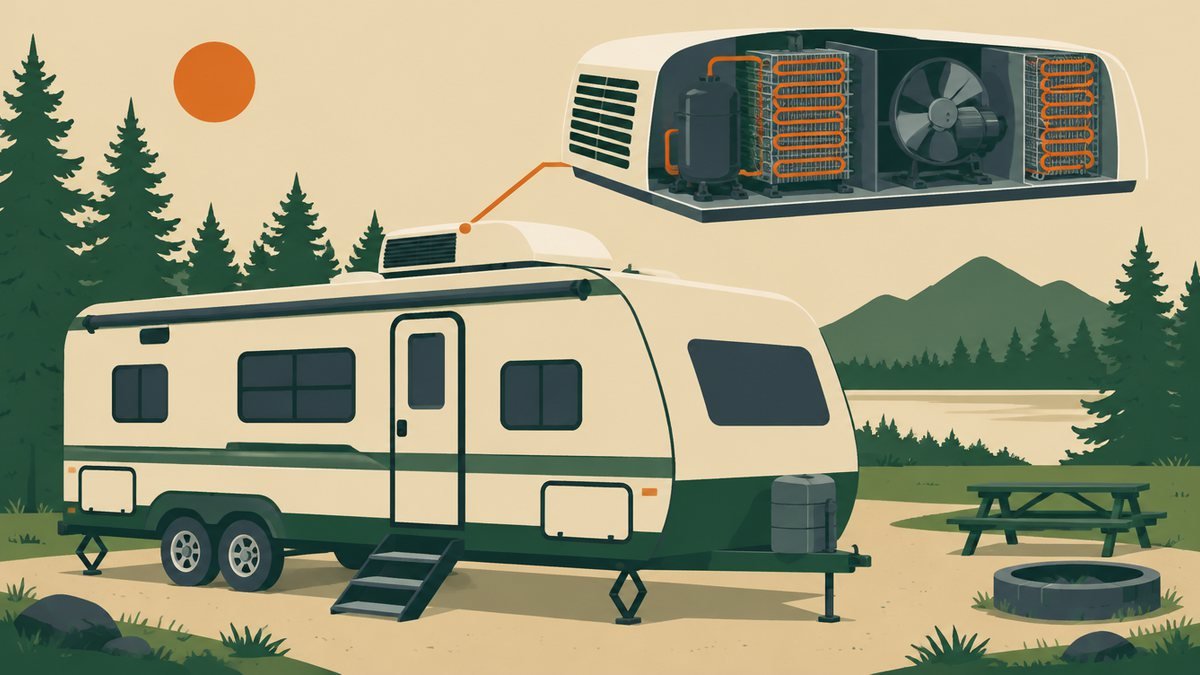
A Dometic RV air conditioner is the unit many RV owners picture when they think of rooftop cooling, since Dometic is one of several manufacturers of RV air conditioners, alongside others such as Coleman-Mach and Furrion. But the brand on the shroud matters less than the type of unit, its cooling capacity and how it fits your RV. Whether you’re replacing a tired unit, adding a second one or just trying to understand what you have, this guide explains how RV air conditioners work, the main types, how BTU ratings work, and what to know about 12-volt options.
How a Dometic RV air conditioner and other rooftop units work
An RV air conditioner works like a household air conditioner in a compact package. Its main parts are:
- The compressor, which pressurizes refrigerant.
- The condenser coil, where hot refrigerant releases heat to the outside air, helped by a fan.
- The evaporator coil, where refrigerant absorbs heat from the air inside the RV.
- The fan motor, which moves air across the coils.
- The thermostat and control board, which control cooling and sometimes a heat strip or heat pump.
- A start capacitor and run capacitor, which help the compressor and fan motors start and run.
Warm air from inside the RV is drawn across the cold evaporator coil, cooled and dried, and pushed back into the cabin. The heat is released outside by the condenser and fan.
Types of RV air conditioners
Rooftop units
The most common type. A rooftop RV air conditioner mounts in a roof opening, usually a standard 14-by-14-inch cutout, with a shroud on top and a ceiling assembly inside. It can be a non-ducted unit that blows air directly from a ceiling vent or a ducted unit that sends air through ductwork in the ceiling to several outlets.
- Non-ducted. Simpler and often easier to replace. Cooling is concentrated near the unit.
- Ducted. Distributes air through the ceiling to several vents, which helps spread cooling in longer RVs.
Low-profile units
Some units have a lower shroud height, which reduces wind resistance and clearance problems. They’re often used where roof clearance is a concern or to improve aerodynamics. Compare the cooling capacity, because compact shapes can change performance.
Heat pump units
Some rooftop air conditioners can also provide heat by reversing the refrigerant flow. Heat pumps work best in mild cold and become less effective as temperatures drop, so they’re best seen as a supplement to a furnace.
Window and portable units
A window-type unit can serve a small trailer or camper, and a portable air conditioner can cool a small space with a vent hose. They’re usually less efficient than rooftop units, and need a way to vent heat outside and handle condensation.
12-volt air conditioners
Some units run on 12-volt DC power, usually from a battery bank, rather than 120-volt AC. A 12v RV air conditioner can run without a generator, which suits vans and boondocking, but its cooling capacity is typically lower than a standard AC unit, and it draws substantial current from the batteries. These systems generally need a large battery bank, often lithium, and a capable charging system. Check the specifications and the runtime you can expect from your battery capacity.

Understanding BTU ratings
Cooling capacity is measured in BTUs, or British thermal units, per hour. A higher number means more cooling capacity. Common rooftop sizes include 13,500 BTU and 15,000 BTU units, with smaller and larger sizes also available. Choosing a size comes down to the volume of the space and how much heat the RV gains.
Factors that affect how much capacity you need:
- The size and layout of the RV. A bigger space needs more cooling.
- Insulation and windows. Poor insulation and large windows let in more heat.
- Climate and sun exposure. Hot, sunny climates need more capacity.
- Slide-outs, which add volume and surface area.
- Humidity, since removing moisture takes energy too.
A larger air conditioner isn’t automatically better. An oversize unit can cool the air quickly and shut off before it removes much humidity, which can leave the RV feeling clammy.
Power requirements
Air conditioners are among the biggest electrical loads in an RV. A typical rooftop unit has a high starting surge and a lower running load. If you use a generator, make sure it can handle the startup. See our guide to RV generators for sizing. On 30 amp service, running two air conditioners may overload the RV’s circuit, so you may need to manage loads. Soft-start devices can reduce the startup surge, allowing smaller generators or inverters to start air conditioners more easily.
Choosing a replacement RV air conditioner
- Match the cutout size and the mounting pattern, which is usually a standard opening, but check.
- Check the ceiling assembly type: ducted or non-ducted, and thermostat type.
- Choose the BTU capacity based on your RV and climate.
- Check the power requirements and make sure your electrical system or generator can run it.
- Consider the noise level and weight. Some units are quieter than others.
- Look at the warranty and parts availability.
- Think about heat pump or heat strip options if you want some heating capacity.
Replacing a rooftop air conditioner involves lifting a heavy unit onto the roof and working with 120-volt wiring, so many owners hire a professional. If you do it yourself, have help, use the correct gasket and fasteners and reseal the roof properly. Our guide to RV roof sealant covers sealing roof openings.
Accessories that help
- Air conditioner covers that protect the unit during storage. Some are designed to stay on without trapping moisture, so follow the manufacturer’s advice, and see our guide on how to winterize an RV for off-season storage.
- Soft-start devices to reduce the starting surge.
- Filters for the ceiling assembly, if your model has one.
- Reflective window covers and shades to reduce heat gain.
- A surge protector or electrical management system to protect the unit from low voltage and surges.
Tips to get better cooling
- Start cooling early, before the RV gets very hot.
- Park in the shade when possible, and use window shades.
- Keep the filter and coils clean. Our guide on RV air conditioner repair and maintenance explains how.
- Run a fan to move air through the RV.
- Close vents and doors in areas you don’t need to cool.
- Avoid running heat-producing appliances such as the oven when you want to cool the RV.
Safety notes
RV air conditioners run on 120-volt power and are heavy. Turn off power at the breaker before removing the shroud or working on the unit. Don’t go on the roof unless it’s designed to hold your weight, and use appropriate fall protection. Refrigerant handling requires training and equipment, so leave sealed-system work to a certified technician. If a unit smells of burning, makes loud noises or trips breakers repeatedly, turn it off and call a technician.
Frequently asked questions
What BTU air conditioner do I need for my RV?
It depends on the size, insulation and climate. Many RVs use 13,500 or 15,000 BTU units, and larger rigs use two or more. A professional or the manufacturer can help you size it.
Can I run an RV air conditioner on a 30 amp hookup?
Yes, with limits. A single unit is usually fine on 30 amp service if you manage other loads. Running multiple air conditioners can overload it.
Can I run an air conditioner off batteries?
Standard rooftop units need 120-volt AC power, which requires an inverter and a large battery bank. A 12-volt unit runs directly from batteries but still uses a lot of power.
Is a heat pump worth it?
If you camp in mild climates and want some heating from the same unit, it can be. In very cold weather, a furnace is still needed.
Sources
Instructions can vary by brand and year, so keep your manual close while you work. The references below support the details in this guide.