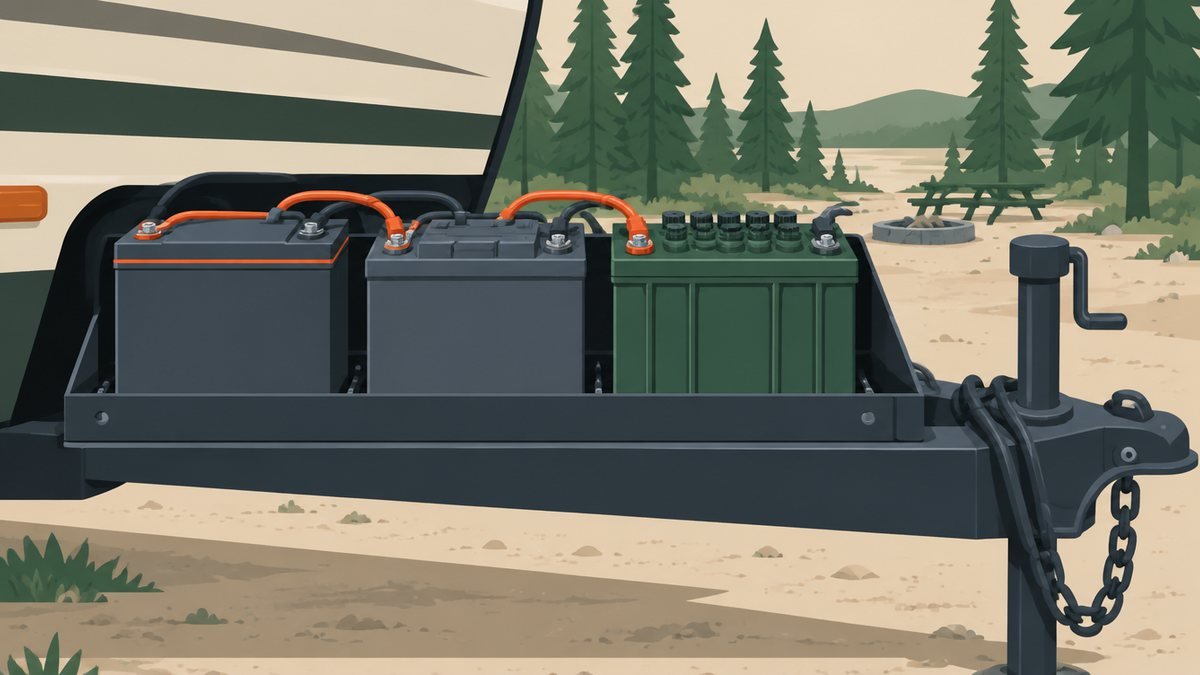
Choosing a deep cycle RV battery is one of the biggest decisions you’ll make for your RV’s 12-volt system. These batteries run your lights, water pump, furnace fan, slide-outs, refrigerator controls and most of the other things that keep working when you’re not plugged in. The three main types, lithium, AGM and traditional lead-acid, behave very differently when it comes to weight, usable capacity, charging needs, maintenance and cost.
This guide explains how RV batteries work, compares the main chemistries, and walks through the questions to ask before you buy or replace your RV house batteries.
Starting batteries vs a deep cycle RV battery
Your RV has two electrical worlds. A starting battery in a motorhome or tow vehicle delivers a short burst of high current to crank the engine. A deep cycle RV battery, also called a house battery, is built to deliver steady power over a long period and to be discharged and recharged many times.
Never use a starting battery as a house battery: it isn’t designed for repeated deep discharges, and it will wear out quickly. House batteries are what we cover here. Many RVs use one or two 12-volt batteries, and some use 6-volt batteries wired in pairs. Battery banks can also be built from several batteries wired together to increase capacity.
The RV solar and battery calculator turns your daily watt-hours into amp-hours for lithium or lead-acid, using Victron’s usable-capacity figures.
Types of RV batteries
Flooded lead-acid
This is the traditional, lower-cost option. Plates sit in liquid electrolyte, so the battery needs to stay upright and vented, and it needs regular maintenance, including checking the water level and topping up with distilled water. Flooded batteries can release gas while charging, so they need a ventilated battery box.
- Pros: lowest purchase price; widely available; proven technology.
- Cons: maintenance required; heavy; should not be discharged very deeply on a regular basis; vented gas; shorter life when abused.
AGM (absorbed glass mat)
An AGM RV battery is a sealed lead-acid design in which the electrolyte is held in glass mats. There’s no water to add, and these batteries tend to be more spill-resistant and vibration-tolerant than flooded ones.
- Pros: maintenance-free; sealed; handles vibration; generally a good middle ground.
- Cons: costs more than flooded; still heavy; like all lead-acid batteries, should not be discharged deeply on a regular basis; can be damaged by overcharging with the wrong settings.
Lithium (LiFePO4)
Lithium iron phosphate batteries, often written LiFePO4 and sold as an RV lithium battery, have become a popular upgrade. They are much lighter than lead-acid batteries of similar capacity and let you use most of their rated capacity without damage.
- Pros: lightweight; a large share of the rated capacity is usable; hold steady voltage as they discharge; accept charge quickly; long cycle life; no maintenance.
- Cons: higher upfront cost; need a compatible charger or charge profile; most should not be charged below freezing unless they include low-temperature protection; their built-in management system may shut them off to protect the cells.
Lithium vs AGM vs lead-acid: how they compare
- Usable capacity. A lead-acid or AGM battery lasts longest when it isn’t regularly discharged very deeply; many manufacturers suggest limiting discharge to about half of capacity. Lithium batteries typically allow much deeper discharge, so a lithium battery with the same rated amp-hours often gives you more usable power.
- Weight. Lithium is far lighter, which matters for towing and payload.
- Lifespan. Lithium generally lasts many more charge cycles, which can offset the higher price over time. Real life depends on how you use and charge them.
- Charging. Lithium accepts higher charge current and charges faster, which helps if you rely on solar or a generator. Lead-acid slows down as it fills.
- Maintenance. Flooded batteries need watering; AGM and lithium do not.
- Cold weather. Cold reduces the capacity of all batteries. Lithium needs extra care when charging in freezing temperatures; check your battery’s specifications.
- Cost. Flooded is cheapest, AGM is in the middle, lithium costs the most upfront.
How to choose the right RV battery
1. Estimate your daily power use
List the 12-volt things you use and for how long: lights, fans, water pump, furnace blower, refrigerator control board, phone and laptop chargers, and any inverter loads. Add up the amp-hours you use in a typical day. This is more important than the label on any battery.
2. Decide how you camp
If you mostly stay at campgrounds with hookups, even a basic battery may be enough. If you boondock for days at a time, deep discharge capability, fast recharging and weight start to matter, and lithium becomes more appealing.
3. Check space and mounting
Measure your battery tray or box, check the terminal positions, and make sure the new battery fits. Heavy lead-acid batteries need secure mounting, and flooded batteries need ventilation.
4. Check charging compatibility
Your converter-charger, solar charge controller, alternator and generator each charge batteries differently. Some older converters aren’t designed for lithium and may not fully charge it. Read the battery maker’s charging requirements, and see our guide to the RV battery charger and disconnect switch for what to check.
5. Think about total cost
Consider how long a battery is likely to last and how many you’ll need, not just the price tag. A cheaper battery you replace more often can cost more in the end.
Wiring basics: series and parallel
Batteries can be wired together to change voltage or capacity:
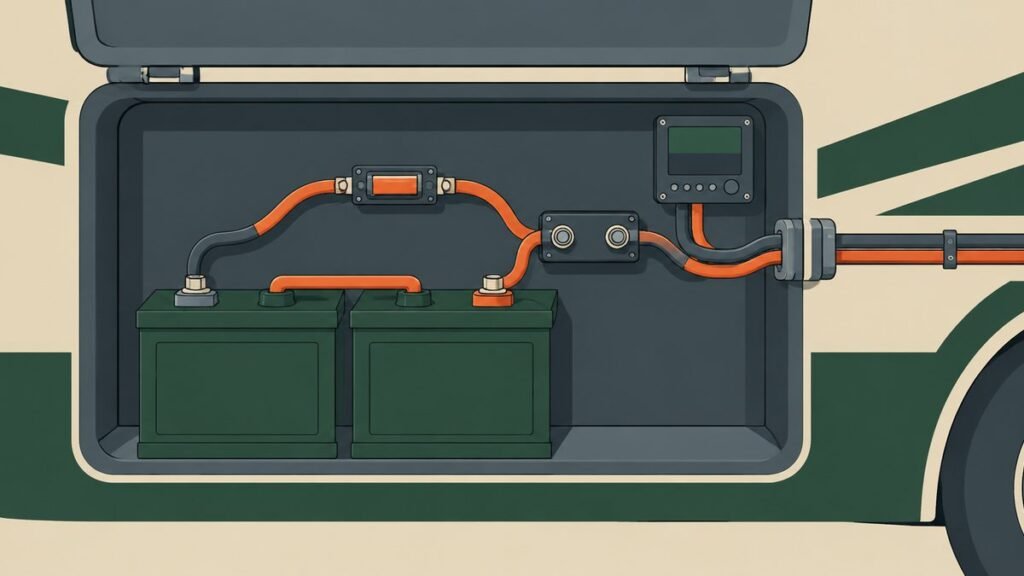
- Parallel (positive to positive, negative to negative) keeps the voltage the same and adds amp-hours. Two 12-volt batteries in parallel give a 12-volt bank with double the capacity.
- Series (positive of one to negative of the next) adds voltage and keeps the amp-hours. Two 6-volt batteries in series make a 12-volt bank.
Use batteries of the same type, age and capacity in a bank, and use properly sized cables, fuses and connectors. Wiring mistakes can cause overheating, so if you aren’t confident, have an RV technician or qualified electrician do the work.
Care and maintenance
- Keep terminals clean and tight.
- Check flooded batteries’ water levels regularly, and use only distilled water.
- Avoid leaving lead-acid batteries discharged; recharge them as soon as practical.
- Use a battery monitor to see state of charge instead of guessing from voltage alone.
- Disconnect or maintain batteries during storage, and follow the manufacturer’s instructions for cold temperatures.
Safety notes
RV batteries can deliver very high current, and a short circuit can cause burns, fires or explosions. Remove rings and metal jewelry, use insulated tools, disconnect the negative terminal first when working, and never lay tools across terminals. Lead-acid batteries contain acid and give off flammable hydrogen gas while charging, so keep sparks and flames away and ventilate the area. Damaged, swollen or hot lithium batteries should be treated as a hazard; stop using them and contact the manufacturer. If you’re unsure, hire a qualified RV technician. If you’re planning a generator, see our guide to RV generators for how they charge your bank, and the 30 amp RV plug guide for shore power basics.
Frequently asked questions
How long will a deep cycle RV battery last?
It depends on the type, how deeply you discharge it, how it’s charged and how you store it. Well-cared-for lithium batteries generally last longer than lead-acid, but there’s no single number that applies to every battery.
Can I mix old and new batteries?
It’s not recommended. Mismatched batteries can charge and discharge unevenly, which shortens the life of the new battery.
Do I need a special charger for lithium?
Often yes, or at least a charger or converter with a lithium profile. Check the battery manufacturer’s requirements before connecting.
Is lithium worth the extra cost?
It can be if you boondock, want to save weight, or want longer life. For occasional campground use, a good AGM or flooded battery may be enough.
Sources
These public agencies, standards organizations and industry groups publish guidance that is a good place to confirm the details on this topic.