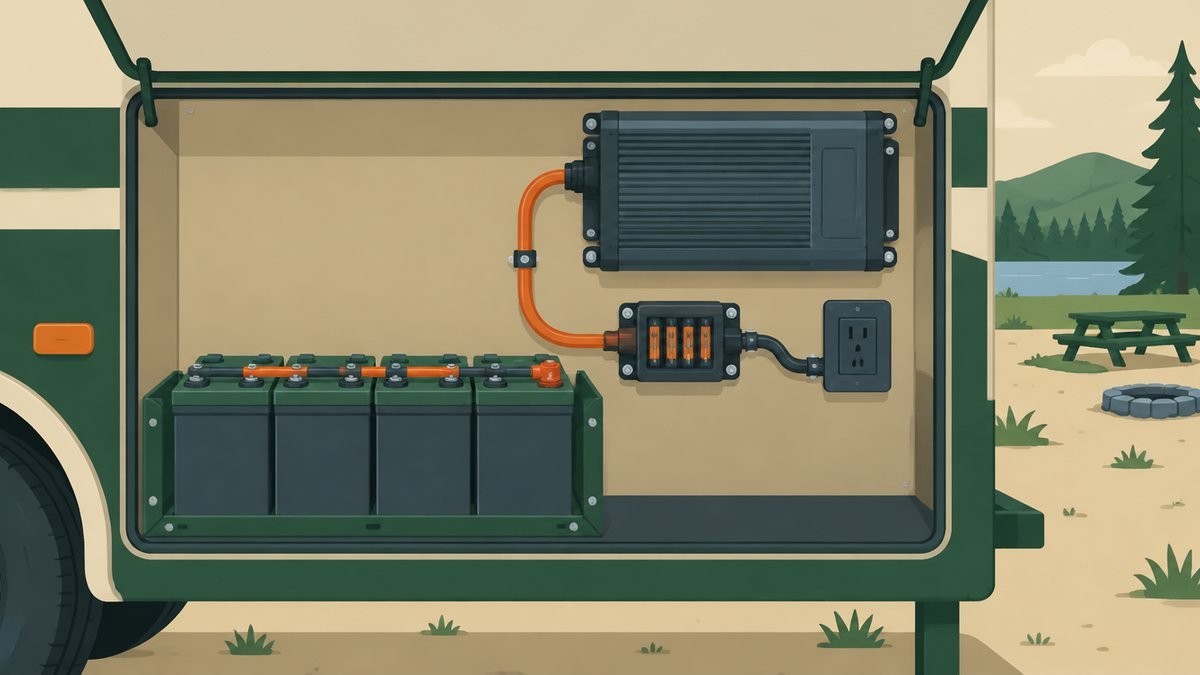
An RV inverter turns the 12-volt DC power stored in your batteries into 120-volt AC power, the same kind that comes out of a household outlet. With one, you can run a laptop, a coffee maker, a TV or even a microwave without shore power or a generator. Choosing and installing the right RV inverter, though, takes more than picking a wattage off a shelf: the size, the waveform, the battery bank and the wiring all have to match what you plan to run.
This guide explains how an RV inverter works, how to size one, what pure sine wave means, how an inverter charger fits in and what a safe installation involves.
Add your inverter loads to the RV solar and battery calculator to see how much solar and battery they call for.
What an RV inverter does
Your RV has two electrical systems. The 12-volt DC system runs lights, the water pump, fans and the control boards of many appliances directly from the house batteries. The 120-volt AC system runs outlets, the air conditioner, the microwave and anything you plug in. On shore power or a generator, a converter-charger supplies the 12-volt side and keeps the batteries charged, and AC flows to the outlets directly.
An inverter goes the other way: it takes power from the batteries and creates AC, so outlets work when you’re off the grid. A power inverter for an RV doesn’t make power, it only converts it, so everything you run drains your batteries.
Pure sine wave vs modified sine wave
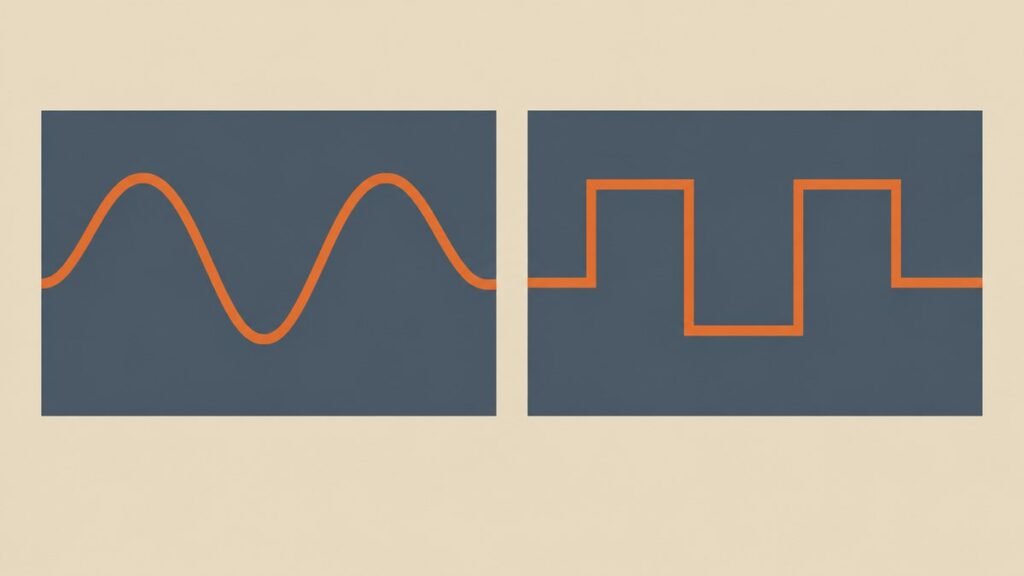
The waveform describes the shape of the AC power the inverter makes.
- Pure sine wave produces a smooth wave much like utility power. It runs almost everything cleanly, including sensitive electronics, motors, medical devices, audio gear and variable-speed appliances. A pure sine wave inverter for an RV is the usual recommendation for most owners.
- Modified sine wave produces a stepped, blockier wave. It’s cheaper and works with simple loads like incandescent lights and basic heaters, but it can cause buzzing, extra heat or malfunction in some electronics and motors, and some devices won’t run at all.
If you aren’t sure what you’ll plug in later, pure sine wave is the safer choice.
How to size an RV inverter
Inverters are rated in watts. You need to size for two numbers: the continuous watts of everything you’ll run at the same time, and the surge, or peak, watts that some loads need for a moment when they start.
Step 1: list what you want to run
Check the label on each device for its wattage. Typical categories:
- Small electronics: phone and laptop chargers, TV, router.
- Kitchen items: coffee maker, toaster, microwave, blender. These draw a lot of power for short periods.
- Motor loads: some pumps and tools need a much larger surge to start than to run.
- Air conditioner: a rooftop unit asks for a very large starting surge. Running one off an inverter generally takes a large inverter, a big battery bank and often a soft-start device. See our guide to the Dometic RV air conditioner and other rooftop units.
Step 2: add up the loads you’ll use together
Add the wattage of items that run at the same time, then add a margin so the inverter isn’t running at its limit all day.
Step 3: check surge
The inverter’s surge rating needs to cover the highest starting load. Look for a surge rating well above the continuous rating if you have motor loads.
Step 4: match the battery bank
The inverter pulls from your batteries, and AC loads need roughly ten times the amps on the DC side as they draw on the AC side, because of the voltage difference plus conversion losses. Large loads can draw hundreds of amps from the battery bank in an instant, so cables, fuses and battery capacity must be up to it. Read our guide to the deep cycle RV battery for how to size the bank, since lithium and lead-acid batteries handle heavy loads differently.
Inverter or inverter charger?
A basic inverter only converts DC to AC. An RV inverter charger combines an inverter with a battery charger in one unit. When shore power or a generator is present, it passes the AC through to your outlets and charges the batteries; when power drops, it switches to inverter mode.
- Advantages: one box does both jobs, with automatic transfer between sources, and often with better multi-stage charging.
- Drawbacks: higher cost and a more complex installation, and it has to work with your RV’s existing converter and wiring so the two chargers don’t fight each other.
Our guide to the RV battery charger explains how charging profiles work, and the RV converter article covers the unit it might replace.
Choosing features
- Waveform. Pure sine wave for most RVs.
- Efficiency and idle draw. Even with nothing plugged in, an inverter draws some power. Look for low idle consumption, and a power-saving mode if you leave it on.
- Transfer switch. Required to feed the RV’s AC panel safely, because you must never connect two AC sources at once.
- Remote panel. Lets you turn it on and off and monitor status from inside.
- Protections. Low-voltage cutoff, overload, over-temperature and short-circuit protection.
- GFCI outlets, if the inverter has built-in ones.
- Cooling and noise. Fans can be loud near sleeping areas.
- Size and mounting. Inverters get hot and need airflow.
RV inverter installation: the safe approach
An RV inverter installation involves high-current DC and 120-volt AC, so mistakes can cause fires and shocks. If you aren’t experienced, have it done by a qualified RV technician or electrician. These are the main points a proper installation covers.
- Mount it close to the batteries, in a ventilated, dry spot, away from flammable materials and away from where battery gases collect.
- Use heavy cables sized for the inverter’s maximum current, kept as short as practical, with solid crimped lugs.
- Fuse the positive cable close to the battery, with a fuse or breaker sized to the cable and the inverter.
- Install a disconnect switch on the DC side so you can isolate the inverter.
- Connect the AC output through a transfer switch or a dedicated sub-panel, never straight to a shore power cord. The inverter’s AC must never be connected to another AC source at the same time.
- Ground it properly, per the manufacturer and applicable codes.
- Follow the code for RVs, and check how your RV’s AC circuits are laid out. NFPA 1192 covers RV safety, and electrical installations follow the National Electrical Code’s RV provisions.
Running appliances on an inverter
- Run the big loads one at a time, and only for short periods when you’re on batteries.
- Watch battery voltage or state of charge. A battery monitor helps you see how much you’ve used.
- Turn the inverter off when you don’t need it, to avoid idle drain.
- Use the generator or solar to recharge, and plan for the energy you used.
- Be careful with heaters and anything that makes heat, such as electric kettles, hair dryers and space heaters. They use a lot of power and drain batteries fast.
Common inverter problems
- Low-voltage alarm or shutdown. The battery voltage dropped under load. Check the batteries, the cable gauge and connections.
- Overload shutdown. You exceeded the continuous or surge rating. Reduce what’s running.
- Noisy fan or overheating. Dust, poor ventilation or a heavy load. Clean and give it airflow.
- Buzzing from audio gear or flickering lights. A modified sine wave inverter may be the cause.
- Outlets dead. Check that the inverter is on, the breaker and the GFCI, and that it’s connected to the outlets you expect.
Safety notes
Inverters and batteries can deliver very high current, which can melt cables and start fires if a connection loosens or a short occurs. Disconnect the batteries before working on the system, use insulated tools and remove metal jewelry. Never connect the inverter’s output to shore power. Keep the inverter dry and ventilated, and keep working smoke and carbon monoxide alarms in the RV. When in doubt, hire a professional.
Frequently asked questions
What size inverter do I need for an RV?
It depends on what you run. Add up the watts of items used at once, check starting surges and size for a margin. A small inverter handles electronics; a microwave or coffee maker needs more; an air conditioner needs a lot more.
Can I run my RV air conditioner on an inverter?
It’s possible with a large inverter, a big battery bank and usually a soft-start device, but it drains batteries quickly. Many owners use a generator for the air conditioner.
Do I need a pure sine wave inverter?
For most RVs, yes. It runs sensitive electronics and motors cleanly. A modified sine wave inverter can work for simple loads but may cause problems with others.
Will an inverter drain my battery when nothing is on?
Yes, a little. Most inverters draw some power when idle, so turn them off when not needed or use a model with a low-power mode.
Sources
These standards organizations and industry groups publish guidance that is a good place to confirm the details on this topic.